HER2 Bispecific Antibody Meets China’s PD-1: In August 2026, the U.S. Food and Drug Administration (FDA) approved two first-line treatment regimens containing Ziihera® (zanidatamab) for adults with HER2-positive, unresectable locally advanced or metastatic gastric cancer, gastroesophageal junction cancer, or esophageal adenocarcinoma (GEA).
One of these regimens is particularly noteworthy for the Chinese innovative pharmaceutical industry: Ziihera + tislelizumab (TEVIMBRA®) + fluoropyrimidine- and platinum-containing chemotherapy.
✨ This means that a PD-1 monoclonal antibody independently developed by a Chinese pharmaceutical company has been incorporated into a combination treatment regimen with a HER2 bispecific antibody and standard chemotherapy, receiving recognition from the U.S. regulatory authority.
For Chinese innovative medicines, the significance of this approval goes beyond simply bringing another Chinese-developed drug to the U.S. market. More importantly, it demonstrates that Chinese innovative drugs are gradually moving from single-product international expansion toward global clinical development and participation in international combination treatment regimens.
What Did the FDA Approve?
The FDA approval covers two first-line treatment regimens containing Ziihera® (zanidatamab) for adults with HER2-positive, unresectable locally advanced or metastatic gastroesophageal adenocarcinoma (GEA):
- Ziihera + tislelizumab + fluoropyrimidine- and platinum-containing chemotherapy for patients with HER2 IHC 3+ or IHC 2+/ISH+ tumors.
- Ziihera + fluoropyrimidine- and platinum-containing chemotherapy for patients with HER2 IHC 3+ tumors.
Both regimens are intended for the first-line treatment of adults with HER2-positive, unresectable locally advanced or metastatic gastric cancer, gastroesophageal junction cancer, or esophageal adenocarcinoma. The approval was primarily supported by results from the global Phase III HERIZON-GEA-01 trial.
For patients, the approval also highlights the growing importance of HER2 testing. Determining the tumor’s HER2 expression status can help physicians assess whether a patient may be eligible for a HER2-targeted treatment approach, together with other clinical factors and the patient’s overall condition.
New Combination Therapy for First-Line Treatment of HER2-Positive Gastroesophageal Cancer
Gastric cancer, gastroesophageal junction cancer, and esophageal adenocarcinoma are challenging malignancies that often require a comprehensive treatment strategy. For patients with unresectable locally advanced or metastatic disease, first-line treatment decisions generally take into account both the molecular characteristics of the tumor and the patient’s overall clinical condition.
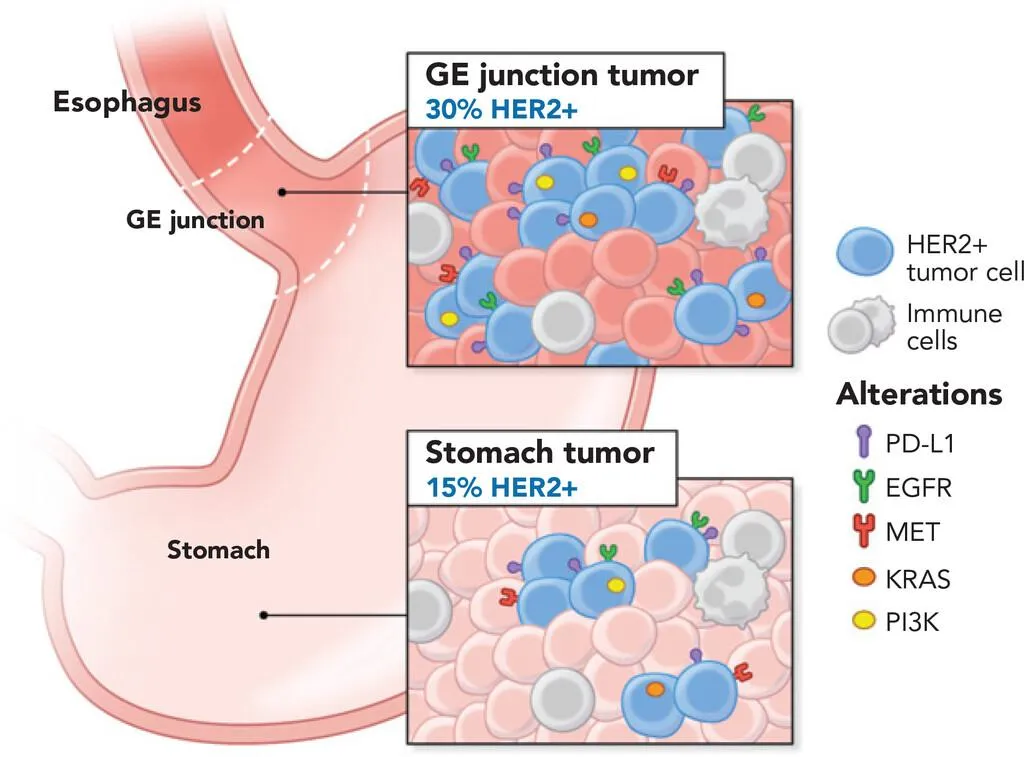
Among these biomarkers, HER2 is particularly important in the treatment of gastric and gastroesophageal junction cancers.
HER2 is a protein involved in signaling pathways that regulate cell growth and proliferation. When certain tumor cells show HER2 overexpression or gene amplification, they may have stronger growth and survival signals.
Therefore, HER2 testing has become an important part of treatment decision-making for patients with advanced gastroesophageal adenocarcinoma. The latest FDA-approved regimens further combine HER2-targeted therapy with immunotherapy and chemotherapy, creating a multi-mechanism treatment approach: HER2 Bispecific Antibody → PD-1 Immunotherapy → Chemotherapy
✨ This combination strategy reflects the continued evolution of treatment for advanced HER2-positive gastroesophageal cancer, with therapeutic approaches increasingly moving beyond a single treatment mechanism toward rational combination therapies.
Two Innovative Medicines: A HER2 Bispecific Antibody and a Chinese PD-1 Inhibitor
The FDA-approved combination regimen features two innovative medicines with distinct mechanisms of action: Ziihera® (zanidatamab-hrii) and tislelizumab (TEVIMBRA®). They target HER2 and PD-1, respectively, and exert their antitumor effects through different mechanisms.
| Item | Ziihera® (zanidatamab-hrii) | Tislelizumab (TEVIMBRA®) |
|---|---|---|
| Drug type | HER2 bispecific antibody | PD-1 monoclonal antibody |
| Primary target | HER2 | PD-1 |
| Key feature | Binds to two different sites on the extracellular domain of HER2 | Blocks the interaction between PD-1 and PD-L1/PD-L2 |
| Main action | Interferes with HER2 signaling and mediates antitumor activity through mechanisms including ADCC, ADCP, and CDC | Helps relieve immune suppression and enhance T-cell antitumor activity |
| Development background | Originally developed by Zymeworks | Independently developed by BeiGene |
| Brand | Ziihera® | TEVIMBRA® |
| Role in the combination | HER2-targeted therapy | Immunotherapy |
| FDA-related treatment | Combined with tislelizumab and/or chemotherapy for HER2-positive GEA | Combined with Ziihera and chemotherapy for first-line treatment of HER2-positive GEA |
Ziihera: From HER2 Bispecific Antibody to First-Line Treatment
Ziihera (zanidatamab-hrii) is a HER2-targeted bispecific antibody.
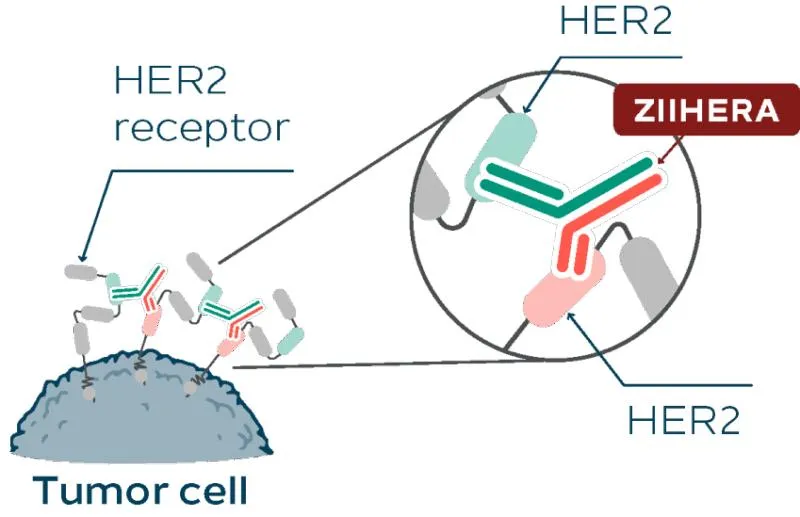
- It can simultaneously bind to two different sites on the extracellular domain of HER2. Compared with antibodies targeting a single epitope, this dual-binding approach enables broader interference with HER2-related signaling.
- Zanidatamab can also promote HER2 internalization and exert antitumor activity through mechanisms including antibody-dependent cellular cytotoxicity (ADCC), antibody-dependent cellular phagocytosis (ADCP), and complement-dependent cytotoxicity (CDC).
✨ The FDA approval further expands Ziihera into the first-line treatment setting for HER2-positive gastroesophageal adenocarcinoma (GEA), highlighting the continued development potential of HER2 bispecific antibodies in solid tumors.
Tislelizumab: A Chinese PD-1 Inhibitor Going Global
If Ziihera represents the development of HER2 bispecific antibody technology, another key medicine in this combination is tislelizumab (TEVIMBRA®). Tislelizumab is a PD-1 monoclonal antibody independently developed by BeiGene. It works by blocking the interaction between PD-1 and PD-L1/PD-L2, helping restore T-cell-mediated antitumor activity.
Unlike Ziihera, tislelizumab does not directly target HER2. Instead, it acts at the level of the immune system. When combined with a HER2-targeted bispecific antibody and chemotherapy, the different mechanisms can complement one another and provide a multi-mechanism approach to tumor treatment.
For the Chinese innovative pharmaceutical industry, tislelizumab carries an even broader significance. Its international development is not simply a story of bringing a Chinese drug to overseas markets. Through global clinical development, it is being incorporated into a combination treatment regimen with an innovative medicine originating from an international biotech company.
Its inclusion in the Ziihera combination regimen represents another example of a Chinese innovative medicine becoming part of a global treatment strategy. It also demonstrates the continued expansion of Chinese-developed PD-1 therapy into the international oncology treatment landscape.
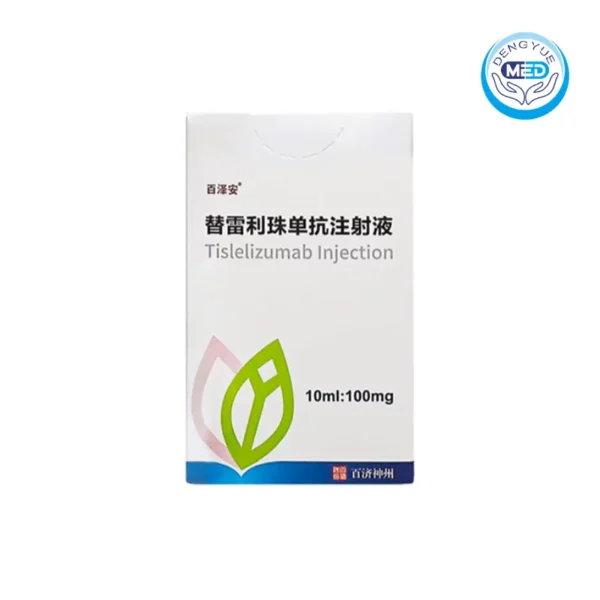
BaiZeAn® | Tislelizumab Injection | Urothelial Carcinoma | DengYueRX
5 in stock
Why Combine a HER2 Bispecific Antibody + PD-1 Inhibitor + Chemotherapy?
The rationale behind this combination is not simply to add more medicines, but to allow different treatment approaches to address different aspects of the disease.
In HER2-positive gastroesophageal adenocarcinoma, abnormal HER2 expression provides an important therapeutic target. At the same time, immune suppression within the tumor microenvironment may limit the body’s ability to mount an effective antitumor response, while chemotherapy can provide a direct cytotoxic effect against tumor cells.
Together, the three approaches offer complementary therapeutic roles:
| Treatment component | Primary role |
|---|---|
| HER2 bispecific antibody—Ziihera | Targets HER2-positive tumor cells and strengthens HER2-directed treatment |
| PD-1 inhibitor—tislelizumab | Helps relieve immune suppression and enhance the body’s antitumor immune response |
| Chemotherapy | Directly targets tumor cells and helps control overall tumor burden |
The treatment strategy can therefore be summarized as:
- Identify the tumor’s key molecular feature → Target HER2
- Activate the body’s antitumor immune response → PD-1 immunotherapy
- Directly control tumor cells → Chemotherapy
Overall, the HER2 bispecific antibody + PD-1 inhibitor + chemotherapy approach integrates targeted therapy, immunotherapy, and chemotherapy into a multi-mechanism treatment strategy for HER2-positive gastroesophageal adenocarcinoma. The positive results from the HERIZON-GEA-01 trial further support the clinical value of this combination approach.
HERIZON-GEA-01: What Were the Results of the Combination Therapy?
An important basis for the FDA approval was the global Phase III HERIZON-GEA-01 trial. The study was jointly conducted by BeiGene and Jazz Pharmaceuticals and enrolled 914 patients across approximately 300 clinical centers in more than 30 countries and regions. The trial evaluated different zanidatamab-based combination regimens against the standard treatment of trastuzumab plus chemotherapy.
Among the treatment arms, Ziihera + tislelizumab + chemotherapy demonstrated a statistically significant improvement in overall survival (OS).
Key Results
| Clinical Endpoint | Ziihera + Tislelizumab + Chemotherapy | Control Group |
|---|---|---|
| Median PFS | 12.4 months | 8.1 months |
| Median OS | 26.4 months | 19.2 months |
| Risk of death | Reduced by approximately 28% | — |
| Risk of disease progression or death | Reduced by approximately 35% | — |
- The median overall survival reached 26.4 months, compared with 19.2 months in the control group—an improvement of 7.2 months. The risk of death was reduced by approximately 28%.
- For progression-free survival, both Ziihera-based combination treatment groups achieved a median PFS of 12.4 months, compared with 8.1 months for the control group, corresponding to an approximately 35% reduction in the risk of disease progression or death.
- Importantly, treatment benefit was also observed across patients with different PD-L1 expression levels. Among patients with PD-L1-negative tumors (TAP <1%), the median OS with the tislelizumab-containing combination reached 29.7 months, compared with 15.8 months in the control group.
✨ Overall, these findings provide clinical support for the role of Ziihera-based combination therapy in the first-line treatment of HER2-positive gastroesophageal adenocarcinoma, while also highlighting the potential value of combining HER2-targeted therapy with PD-1 immunotherapy and chemotherapy.
From Ziihera and Tislelizumab: A New Stage for Chinese Innovative Medicines Going Global
Over the past several years, the internationalization of Chinese innovative medicines has undergone significant changes. In the earlier stage, a common pathway was: Chinese R&D → Overseas Licensing → International Clinical Development → Overseas Commercialization. This model helped many Chinese innovative medicines enter international markets and led to numerous cross-border licensing partnerships.
👉 As Chinese pharmaceutical companies continue to strengthen their global R&D and regulatory capabilities, however, the approach to international expansion is evolving. More Chinese companies are now participating in global multicenter clinical trials and becoming directly involved in international regulatory submissions and commercialization, either independently or through strategic partnerships.
Tislelizumab is a representative example of this transition.
In the FDA-approved combination regimen, tislelizumab, a PD-1 inhibitor independently developed by a Chinese pharmaceutical company, is combined with Ziihera, a HER2 bispecific antibody originally developed by Zymeworks, and chemotherapy as a first-line treatment regimen. The combination was evaluated through a global Phase III clinical trial and subsequently received recognition from the U.S. regulatory authority.
This demonstrates that the international value of Chinese innovative medicines is evolving beyond simply “entering overseas markets” and increasingly extending to “becoming part of global treatment strategies.” From this perspective, the collaboration between Ziihera and tislelizumab also reflects a broader shift in the global drug development model: Different companies → Different technology platforms → Different mechanisms of action → Global clinical collaboration → Combination treatment
In the future, competition in innovative medicines may increasingly extend beyond individual products. It may also involve greater collaboration among medicines, technology platforms, and pharmaceutical companies to develop new treatment strategies.
For Chinese pharmaceutical companies, the key question is therefore changing: In the past, the focus was “Can Chinese innovative medicines go global?”
Today, an even more important question is, “Can Chinese innovative medicines become part of global treatment strategies?”

✨ When a Chinese innovative medicine participates in global clinical development, gains international regulatory recognition, and becomes an integral component of a global combination treatment regimen, its value extends beyond that of an “exported product.” It represents the combined strength of Chinese drug discovery, clinical development, regulatory capabilities, and international collaboration.
The transition from “product globalization” to “treatment-strategy globalization” may be one of the most important signals of the next stage in the global development of Chinese innovative medicines.
From Chinese Innovative Medicines Going Global to Global Supply: DengYuePharmacy Connecting Chinese Medicines with International Markets
As more Chinese innovative medicines gain international recognition, interest in Chinese pharmaceutical products is also growing among overseas healthcare institutions, professional buyers, and patients. For these innovative medicines, gaining recognition in international markets is only the first step; establishing a stable and reliable supply is equally important.
For specialized medicines such as oncology biologics and monoclonal antibodies, international supply involves more than the medicines themselves. Key considerations include:
- Product origin and authenticity
- Proper storage conditions
- Cold-chain transportation requirements
- Supply stability
- Cross-border logistics
- Local regulatory and procurement requirements
Therefore, bringing Chinese innovative medicines to global markets requires not only strong R&D, clinical development, and regulatory capabilities, but also a reliable international pharmaceutical supply network.
DengYuePharmacy is committed to serving as a professional channel connecting Chinese pharmaceutical resources with international customers. We focus on Chinese innovative medicines and specialized pharmaceutical products, providing international customers with support including product information, pharmaceutical procurement, supply-chain coordination, and cross-border pharmaceutical services.
For overseas healthcare institutions, pharmaceutical buyers, and professional customers looking for Chinese innovative medicines, oncology treatments, and other specialized pharmaceutical products, DengYuePharmacy can provide relevant product information and procurement support based on specific requirements.
If you are looking for innovative medicines or specialized treatments from China, contact DengYuePharmacy to learn more about available products and procurement support.
Conclusion
🌐 The FDA approval of the Ziihera and tislelizumab combination represents more than another advancement in HER2 bispecific antibody and PD-1 combination therapy. From a broader industry perspective, it also highlights the growing role of Chinese innovative medicines in global drug development and international treatment strategies.
Tislelizumab’s journey from independent Chinese drug development to global clinical development and ultimately to becoming an important component of an international combination treatment regimen demonstrates how the value of Chinese innovative medicines is expanding beyond individual products to include global clinical value and participation in international treatment strategies.
For the Chinese innovative pharmaceutical industry, this may be one example of a broader trend. As more Chinese innovative medicines gain international recognition, the idea that “HER2 bispecific antibody meets China’s PD-1” is becoming a practical example of how Chinese innovation can become part of global treatment strategies. More Chinese-developed medicines are moving beyond simply entering overseas markets and toward meaningful participation in global healthcare.
FAQ About HER2 Bispecific Antibody Meets China’s PD-1
What is Ziihera (zanidatamab)?
Ziihera® (zanidatamab-hrii) is a HER2 bispecific antibody that targets two different sites on HER2. It is designed to interfere with HER2 signaling and promote antitumor immune mechanisms. It is used in combination treatment for certain patients with HER2-positive gastroesophageal adenocarcinoma (GEA).
What is tislelizumab (TEVIMBRA®)?
Tislelizumab (TEVIMBRA®) is a PD-1 monoclonal antibody independently developed by BeiGene. By blocking the interaction between PD-1 and PD-L1/PD-L2, it helps restore T-cell-mediated antitumor activity. It is an important example of a Chinese innovative medicine entering global clinical development.
Why are Ziihera and tislelizumab used together?
The two medicines target different biological mechanisms. Ziihera targets HER2-positive tumor cells, while tislelizumab acts on the immune system through the PD-1 pathway.
When combined with chemotherapy, the three approaches provide a multi-mechanism treatment strategy for eligible patients with HER2-positive GEA.
What did the FDA approve for HER2-positive gastroesophageal cancer?
The FDA approved two Ziihera-based first-line treatment regimens for adults with HER2-positive, unresectable locally advanced or metastatic GEA.
One combines Ziihera + tislelizumab + fluoropyrimidine- and platinum-containing chemotherapy, while the other combines Ziihera + fluoropyrimidine- and platinum-containing chemotherapy for patients with HER2 IHC 3+ tumors.
Can I purchase Ziihera or tislelizumab through DengYuePharmacy?
DengYuePharmacy provides pharmaceutical product information and procurement support for international customers seeking Chinese medicines and specialized treatments.
Availability, regulatory requirements, shipping conditions, and procurement arrangements may vary by country and product. Contact DengYuePharmacy for product and procurement information.